Prefer to view the formatted PDF? Click below.
Download the Full White Paper (PDF) ↓Why Excel, survey tools, and internal apps fail clinical research teams — a practical business case for implementing validated eClinical systems. A ClinCapture Captivate® Community White Paper.
Executive Summary
The electronic data capture market has matured considerably, and with that maturity has come a paradox: more choices, but less clarity. Today’s clinical teams must navigate a crowded vendor landscape where every platform claims to offer speed, compliance, and simplicity — yet the real differences only surface after contracts are signed and studies are live.
This white paper cuts through the noise. It offers sponsors, CROs, and academic institutions a structured framework for evaluating EDC solutions with confidence. It focuses on the four capabilities that most reliably predict long-term success and the four warning signs that most reliably predict regret.
The framework is built around three strategic questions every evaluation team must answer:
- Independence — Can your team operate without submitting a work order every time a protocol changes or a new query needs to be raised?
- Growth Compatibility — Will this platform serve a single Phase I study as effectively as it serves a multi-site, multi-country Phase III program five years from now?
- Financial Integrity — Are the costs you will pay in year three as predictable as the costs you agreed to on day one?
Introduction
A poorly chosen EDC platform does not announce itself on the first day of a study. The warning signs emerge gradually: a protocol amendment that takes three weeks instead of three hours, a budget variance that cannot be explained to finance, a database lock that slips because reporting tools cannot surface the right data in time. By that point, switching platforms is rarely an option.
Historically, organizations defaulted to selecting systems based on brand familiarity or the lowest quote received during procurement. The landscape is fundamentally different today. Teams must evaluate not just what a system can do, but how it does it — and who retains control when it matters most.
Why Many Studies Begin with DIY Systems
Most organizations that rely on Excel or survey tools are not intentionally avoiding validated systems. Instead, these decisions are usually driven by practical constraints common in early-stage research organizations.
- Limited Budgets: Early-stage companies often prioritize scientific development over infrastructure investment.
- Small Clinical Teams: Many startups launch studies with minimal clinical operations staff.
- Internal Development Optimism: Engineering teams may believe internal systems can be built quickly and inexpensively.
- Lack of regulatory familiarity: Executives outside clinical operations may not fully understand regulatory requirements for clinical data systems.
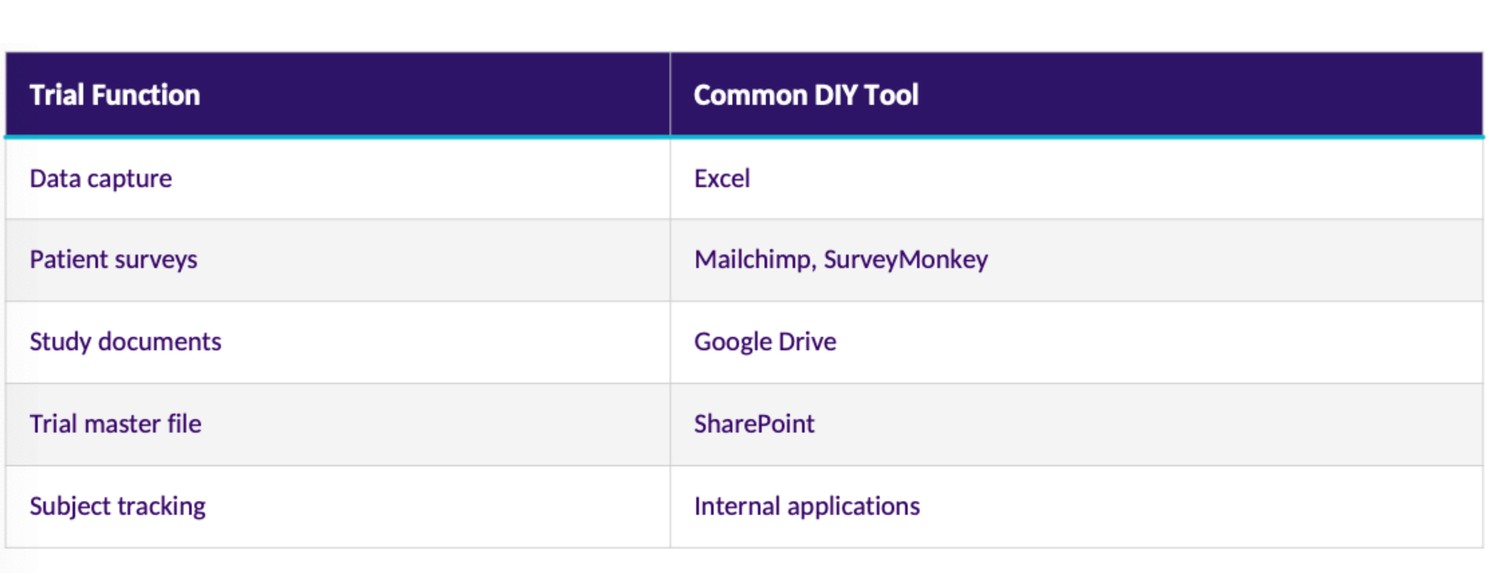
Because of these factors, many studies begin using combinations of general software tools. While this approach may appear workable at the beginning of a study, significant limitations quickly emerge as research progresses.
Table 1. Trial Functions and Commonly Used Tools
Regulatory Risk: The Hidden Cost of DIY Clinical Data Systems
One of the most significant risks of using improvised clinical data systems is regulatory non-compliance. Clinical trials that support regulatory submissions must follow strict requirements governing data integrity, traceability, and system validation.
These standards are enforced by regulatory authorities worldwide, including:
- US Food and Drug Administration (FDA)
- European Medicines Agency (EMA)
- MHRA (United Kingdom)
- Health Canada
- PMDA (Japan)
General-purpose tools such as Excel spreadsheets, survey platforms, and cloud file storage systems were not designed to meet these regulatory standards. As a result, organizations that rely on these tools may unknowingly expose their studies to significant regulatory risk.
21 CFR Part 11 Compliance Risks
In the United States, electronic records used in FDA-regulated clinical trials must comply with 21 CFR Part 11. This regulation requires systems to maintain secure user authentication, electronic signatures, complete audit trails, controlled access to records, protection against unauthorized data changes, and validated system performance. Most general-purpose software tools do not provide these capabilities.
Table 2. DIY Tool Compliance Gaps
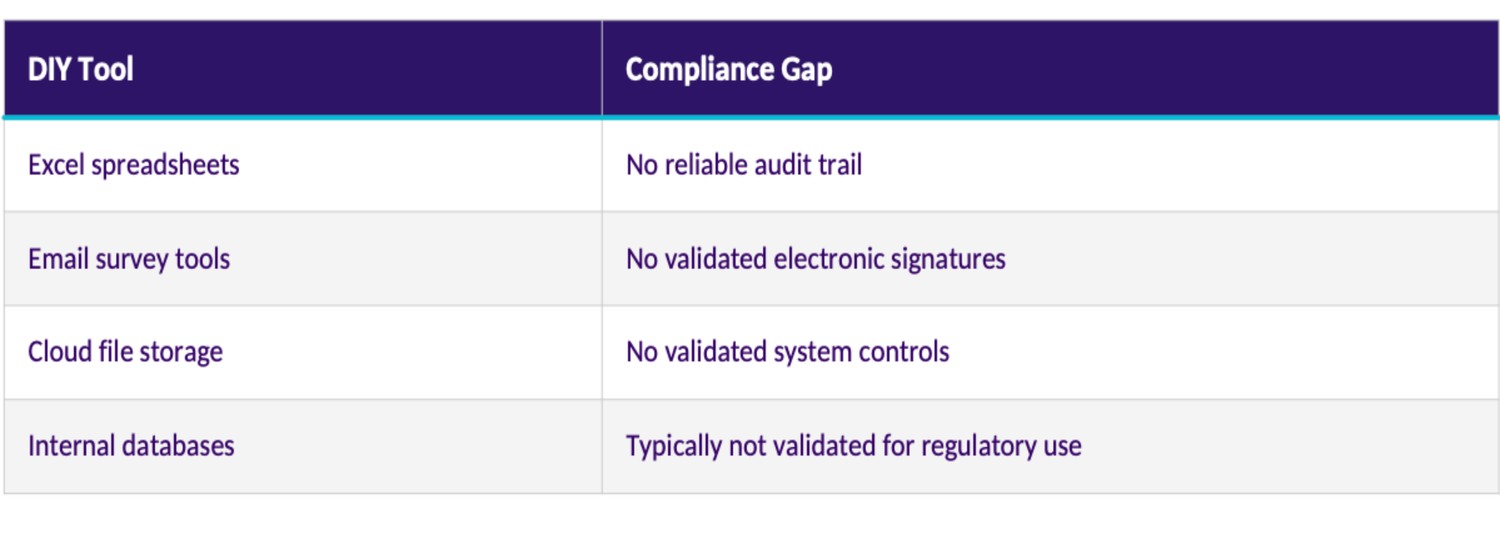
Without these protections, regulators cannot verify who entered data, when changes were made, or whether records were altered — directly undermining the regulatory concept of data integrity.
Data Privacy Risks (GDPR and HIPAA)
Clinical trials frequently involve sensitive personal information, including Protected Health Information (PHI), Personally Identifiable Information (PII), and genetic and biomarker data. Improvised systems may fail to meet requirements under HIPAA (U.S.), GDPR (EU), and national data protection laws in many jurisdictions. Improper handling can lead to regulatory investigations, mandatory breach notifications, financial penalties, and reputational damage.
Real-World Consequence: Study Data Rejection
In some cases, sponsors discover compliance gaps only after significant data has already been collected. When regulators determine that electronic records cannot be trusted due to missing audit trails or absent system validation, the data may be considered unreliable for regulatory submission. Remediation can require:
- Repeat Data Collection
- Reconstruct Missing Audit Trails
- Migrate Data into Validated Systems
- Conduct additional monitoring and verification
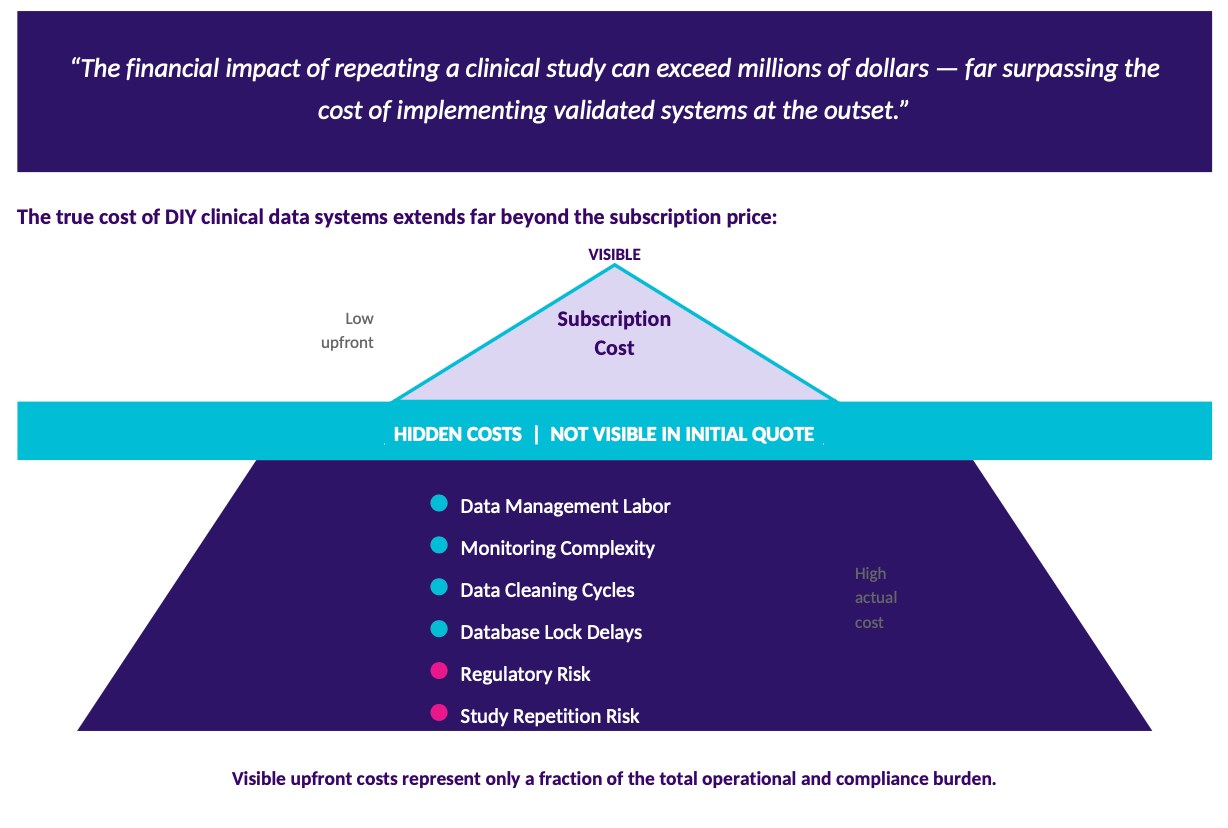
Infographic 2. The Hidden Cost Iceberg
Data Quality and Data Integrity Risks
Clinical trial data must be accurate, traceable, and auditable. General-purpose software tools lack built-in mechanisms that ensure data integrity. Common issues include:
- Inconsistent data formatting
- Missing fields or incomplete records
- Manual transcription errors
- Difficulty tracking changes to data
These issues often lead to extended data cleaning cycles and delayed database lock. Modern electronic data capture systems address these challenges through structured data entry and configurable validation rules that automatically identify potential errors during data entry, significantly reducing downstream data cleaning requirements.
The Build vs. Buy Misconception in Clinical Software
Many early-stage biotechnology companies consider building internal tools to manage clinical data. At first glance, this approach may appear attractive. Internal development teams are already familiar with the company’s technology stack, and a custom solution may seem less expensive than purchasing commercial clinical software.
However, building a compliant clinical data system requires far more than basic software development. EDC systems used in regulated clinical trials must satisfy strict requirements related to validation, auditability, security, and regulatory compliance — requirements that dramatically increase the complexity of building and maintaining an internal system.
Regulatory Validation Requirements
One of the most significant challenges in developing clinical software internally is system validation. Under regulatory frameworks such as FDA 21 CFR Part 11, EU Annex 11, and Good Clinical Practice (GCP), software used to collect clinical trial data must be formally validated to demonstrate it consistently performs as intended. Validation typically requires:
- Documented system requirements and risk assessments
- Installation qualification (IQ), operational qualification (OQ), and performance qualification (PQ)
- Test scripts and formal validation reports
- Change control procedures for any system modification
For commercial clinical platforms, this validation documentation often consists of hundreds or even thousands of pages of testing evidence. Maintaining validation over time also requires re-testing whenever the system is modified — a significant ongoing burden for most internal engineering teams.
Audit Trail and Data Integrity Requirements
Regulatory authorities require clinical data systems to maintain complete and immutable audit trails. The system must record who entered or modified data, when changes occurred, what values were changed, and why changes were made. Audit trails must be secure, tamper-evident, and easily accessible during regulatory inspections. Designing and validating a compliant audit trail architecture is one of the most technically complex aspects of clinical software development.
Security, Privacy, and Long-Term Maintenance
Clinical trial systems store sensitive patient information and must comply with HIPAA, GDPR, and regional privacy laws. Compliance requires secure infrastructure, encryption protocols, access controls, logging, and documented security procedures. Even if an internal system can be built successfully, maintaining it over several years of trial duration presents additional ongoing challenges including software maintenance, security patching, validation updates, and user support.
Operational Inefficiency
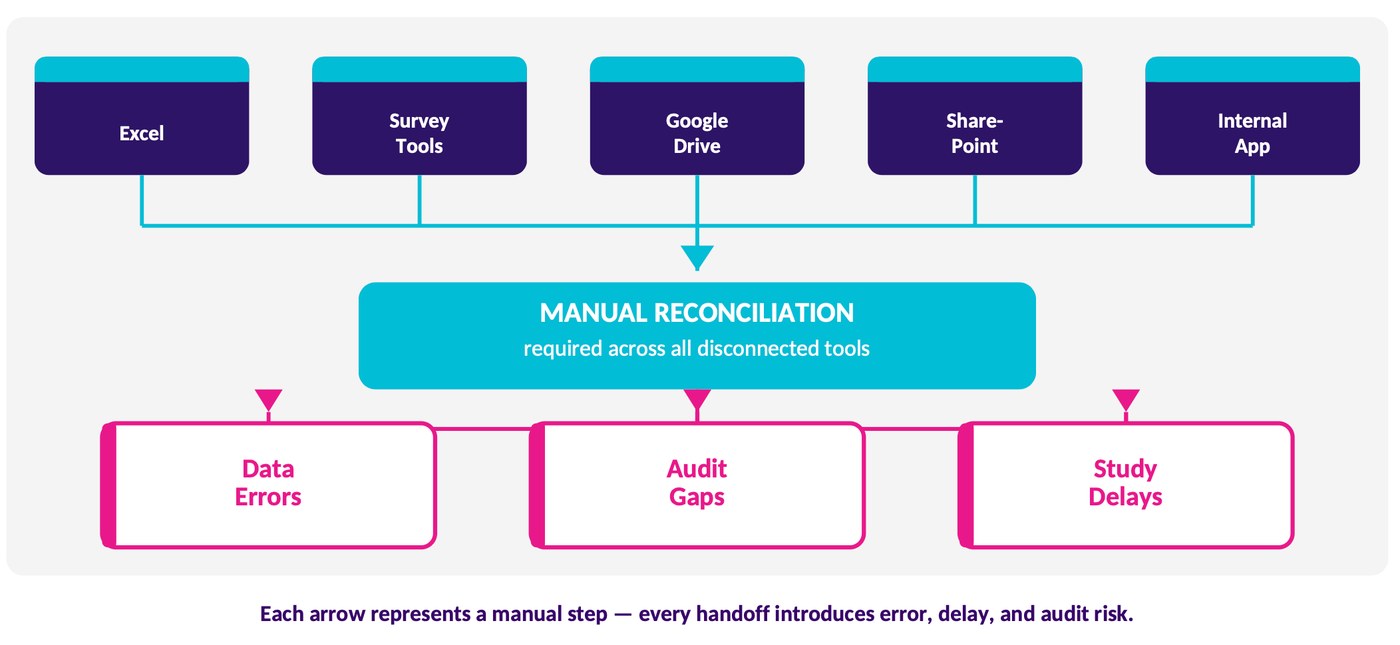
Workflow Fragmentation
DIY systems typically involve multiple disconnected tools. This fragmentation creates inefficiencies throughout the study lifecycle. Clinical teams must manually reconcile spreadsheets, transfer survey data between systems, track document versions, and merge datasets for statistical analysis. These manual processes slow down key study milestones:
- Monitoring Reviews
- Data Cleaning
- Database Lock
- Statistical Analysis
Integrated clinical platforms eliminate these inefficiencies by centralizing study data within a single system, reducing manual handoffs and the errors they introduce.
The True Cost of Clinical Data Infrastructure
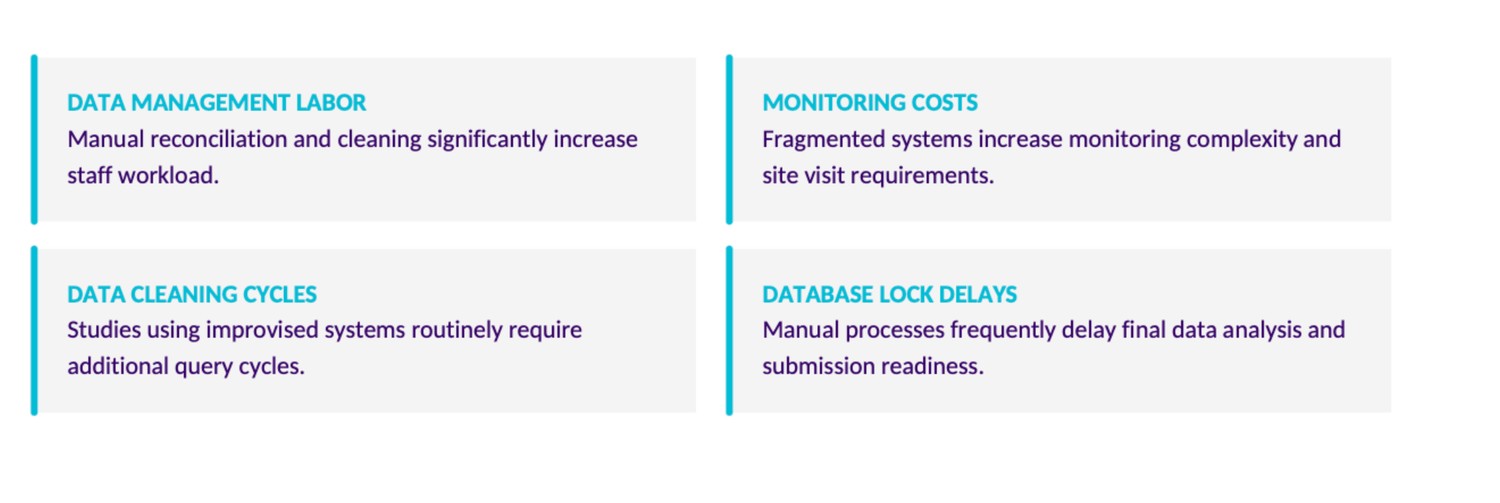
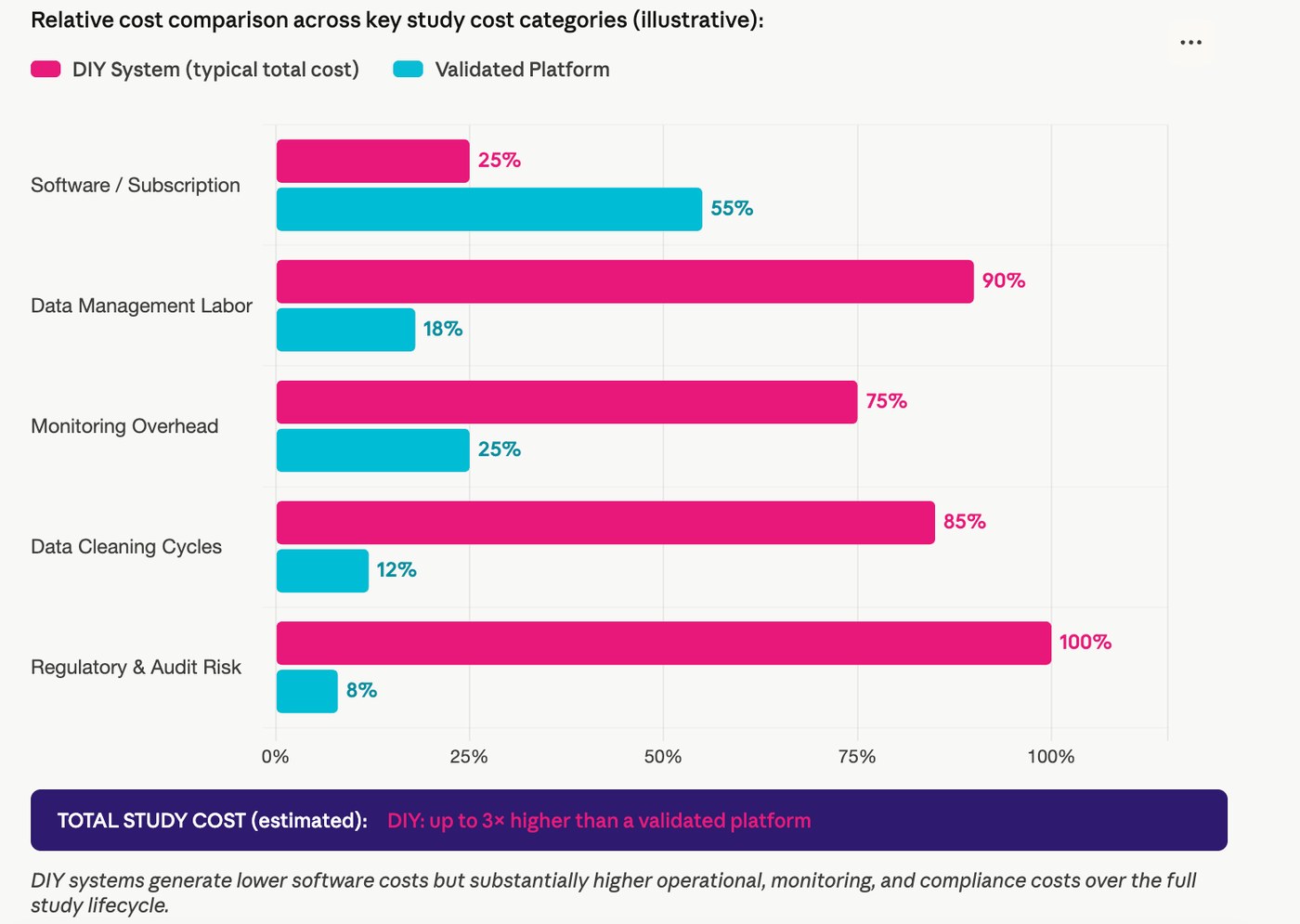
When evaluating clinical technology, many organizations focus only on software subscription costs. However, the true cost of clinical infrastructure encompasses multiple operational dimensions that compound over the life of a study.
Table 3. Clinical Data Components
When Organizations Typically Adopt Validated Systems
Many organizations transition to validated clinical systems after encountering challenges with improvised infrastructure. Transitioning earlier in the clinical development process can prevent costly system migrations and data reconciliation later.
Common triggers for adoption:
- Launching a regulated clinical trial
- Expanding to multiple study sites
- Preparing for regulatory submission
- Increasing monitoring requirements
- Receiving audit findings related to data integrity
Modern eClinical platforms allow research teams to manage data capture, patient-reported outcomes, randomization, reporting and analytics, and regulatory compliance within a unified system — eliminating the fragmentation that characterizes DIY approaches.
The Strategic Advantage of Purpose-Built Platforms
For organizations conducting regulated clinical research, clinical data infrastructure is a critical component of study success. Purpose-built eClinical platforms allow research teams to reduce regulatory risk, accelerate study startup, improve data quality, and streamline monitoring and analysis. Rather than building and maintaining complex software internally, many sponsors choose to implement validated systems designed specifically for clinical research — allowing their teams to focus on advancing therapies while ensuring clinical data remains compliant and ready for regulatory submission.
Prefer to view the formatted PDF? Click below.
Download the Full White Paper (PDF) ↓About Captivate®
Captivate is a modern eClinical platform developed by ClinCapture to support flexible, operationally scalable clinical trial workflows. Purpose-built for regulated clinical research, Captivate helps sponsors and CROs reduce regulatory risk, accelerate study startup, improve data quality, and streamline monitoring and analysis within a single validated system.
To learn more about implementing validated clinical infrastructure, contact the ClinCapture team at [email protected] or visit www.captivate.org.