Prefer to view the formatted PDF? Click below.
Download the Full White Paper (PDF) ↓Why reporting flexibility is becoming a critical EDC differentiator in modern clinical research. A ClinCapture Captivate® Community White Paper.
Executive Summary
For years, Electronic Data Capture (EDC) systems were evaluated primarily on their ability to collect and store clinical trial data. If a platform could support study startup, maintain compliance, and capture data effectively, it was generally considered sufficient. That standard is rapidly changing.
Modern clinical trials generate significantly more operational, patient, and analytical data than traditional EDC architectures were originally designed to support. Sponsors now operate studies that include decentralized workflows, integrated ePRO environments, wearable devices, biomarker datasets, and increasingly sophisticated downstream analytics initiatives. As study complexity has evolved, operational reporting has become far more than a secondary platform feature—it has become a critical component of trial execution itself.
Yet many sponsors are discovering that the reporting capabilities within their EDC systems are far more limited than expected. What initially appears to be a flexible reporting environment during vendor evaluations often turns into a collection of rigid dashboards, delayed synchronization workflows, disconnected datasets, and vendor-dependent reporting processes once studies become operationally complex.
These limitations rarely appear during the evaluation process. They emerge later, often after enrollment accelerates, executive reporting requirements expand, or biometrics teams begin preparing downstream analyses. By that stage, changing systems is rarely practical. Instead, organizations frequently build inefficient manual workflows around reporting limitations, creating operational burden that compounds throughout the study lifecycle.
As clinical research becomes increasingly decentralized, data-intensive, and analytics-driven, reporting flexibility is becoming one of the most important strategic differentiators in modern eClinical technology selection.
The Evolution of Clinical Trial Reporting
Traditional EDC systems were designed during a period when clinical trial operations were comparatively straightforward. Most studies relied on site-entered CRFs, periodic monitoring visits, relatively static reporting requirements, and smaller datasets with limited downstream analytics dependencies. In that environment, standard dashboards and predefined exports were often sufficient to support operational oversight and database lock activities.
Modern clinical trials operate very differently. Today’s studies frequently span multiple operational systems and generate continuous streams of data across decentralized patient workflows, integrated ePRO environments, wearable devices, imaging platforms, laboratory systems, and advanced biomarker initiatives. At the same time, sponsors increasingly expect near-immediate operational visibility into enrollment trends, protocol compliance, patient activity, monitoring performance, and study health metrics.
This shift has fundamentally changed the role of reporting within clinical operations. Reporting is no longer simply a retrospective activity performed near database lock. It has become an active operational workflow that directly influences study execution, patient oversight, monitoring efficiency, executive decision-making, and downstream analytics readiness.
As a result, sponsors increasingly require reporting environments that are flexible, operationally scalable, and capable of adapting alongside evolving study complexity. Unfortunately, many EDC reporting architectures were not originally designed for this level of operational demand.
Why Reporting Limitations Often Appear Mid-Study
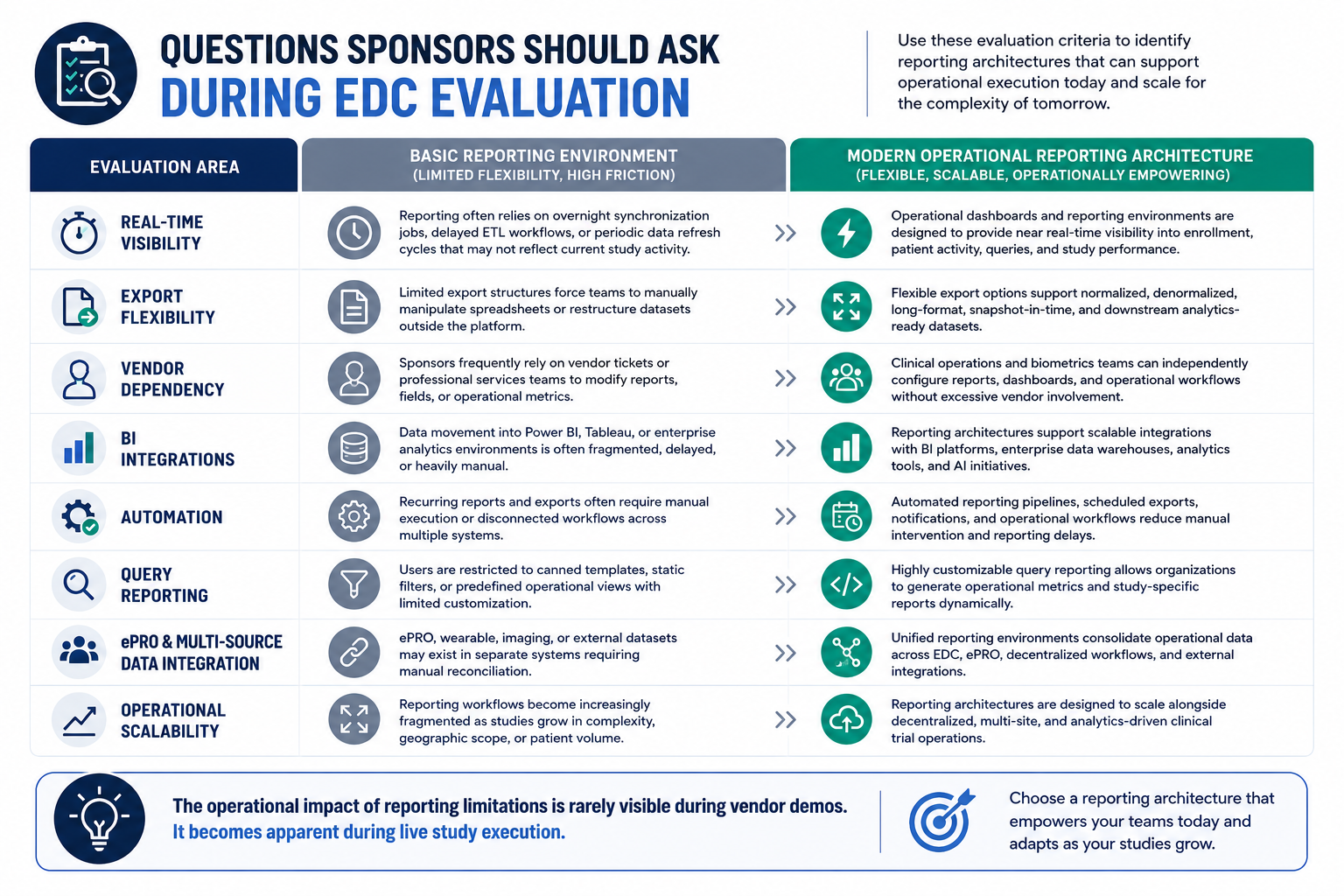
One of the most common challenges in EDC selection is that reporting limitations are often difficult to identify during the evaluation process. During vendor demonstrations, sponsors naturally focus on highly visible platform capabilities such as study startup timelines, ePRO functionality, integrations, compliance, and user experience. Reporting is frequently discussed at a high level, often summarized simply as “the platform includes dashboards and reporting tools.”
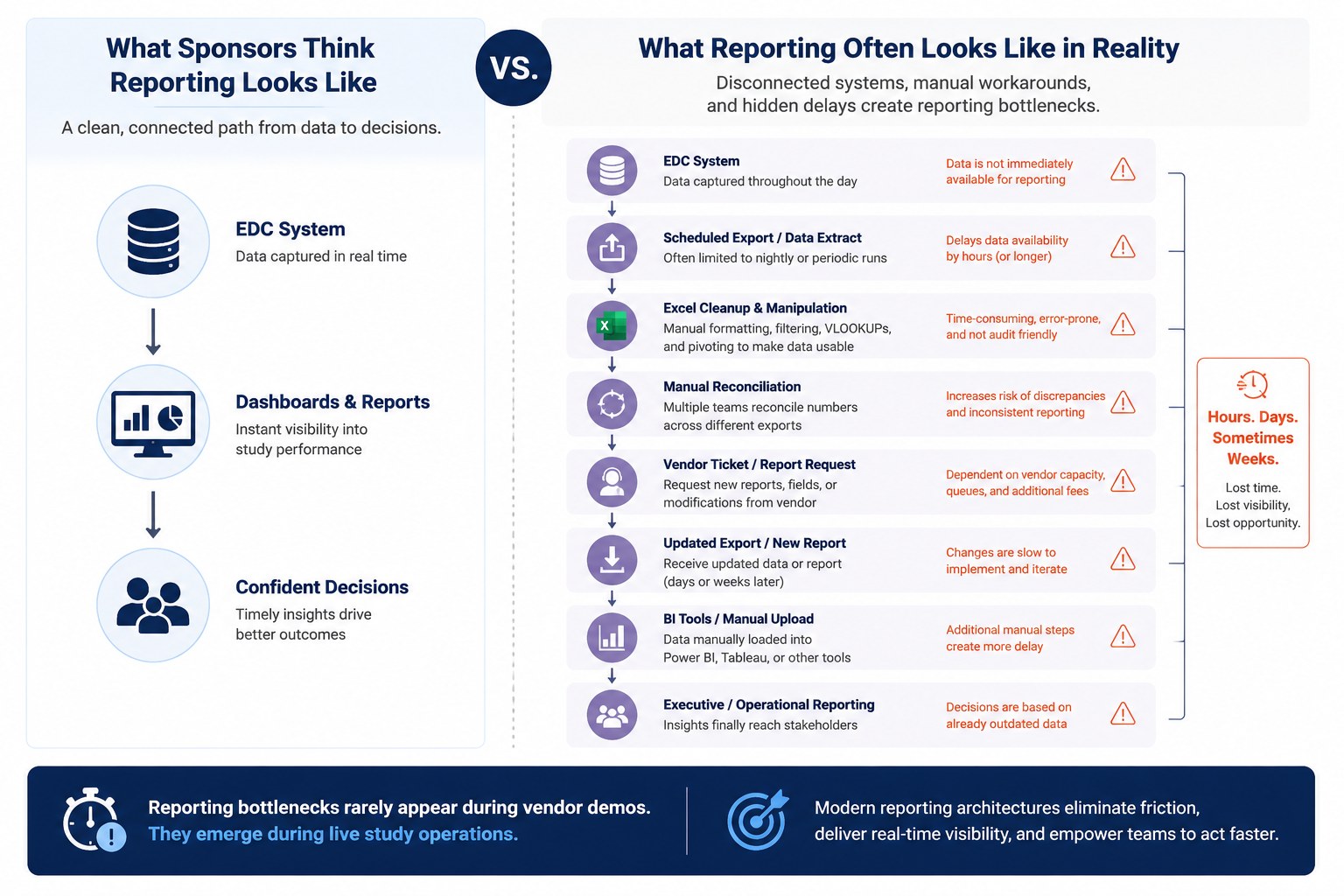
The operational reality tends to emerge much later. Reporting limitations rarely become apparent during a scripted demo environment. They typically surface once studies become operationally complex and internal teams begin relying on the platform for day-to-day decision-making. This often occurs several months into a live study, when enrollment volumes increase, operational reporting requirements evolve, and executive teams begin requesting increasingly granular visibility into study performance.
At that point, sponsors frequently discover that reporting flexibility is far more constrained than initially expected. Operational teams may encounter rigid export structures, disconnected datasets, delayed synchronization cycles, or limitations that require vendor involvement for relatively simple reporting modifications.
Because studies are already active, organizations often have little choice but to build manual workarounds around the platform itself. Clinical operations teams begin reconciling spreadsheets manually. Biometrics groups restructure exports independently. Reporting pipelines become fragmented across multiple disconnected workflows. Over time, these inefficiencies become normalized operational processes even though they originated as platform limitations rather than study requirements.
The Misconception of “Real-Time Reporting”
“Real-time reporting” has become one of the most heavily marketed concepts within modern eClinical software. In practice, however, the term often means very different things depending on the underlying platform architecture.
Many EDC environments marketed as “real time” still rely heavily on overnight synchronization workflows, delayed ETL processes, scheduled refresh cycles, or disconnected reporting databases. In some cases, operational dashboards may lag several hours behind actual study activity despite appearing dynamic during demonstrations.
For studies with relatively simple operational requirements, these delays may appear manageable. However, the impact becomes significantly more pronounced in decentralized trials, integrated ePRO workflows, symptom-driven patient engagement models, and studies involving high-frequency wearable or remote monitoring data.
Operational teams increasingly require immediate visibility into current study activity rather than delayed overnight snapshots. Delays in reporting refresh cycles can affect enrollment tracking, query management, protocol deviation visibility, patient oversight, and executive reporting accuracy. In fast-moving clinical environments, even relatively small delays in operational visibility can create downstream inefficiencies across multiple functional groups.
The issue is not simply whether dashboards refresh quickly. It is whether the reporting architecture itself was designed to support continuously active operational workflows rather than periodic retrospective reporting.
Clinical Trials No Longer Need Data Repositories. They Need Operational Data Infrastructure.
Historically, EDC systems primarily functioned as repositories for clinical trial data. Their primary responsibility was to collect information, maintain compliance, and prepare datasets for statistical analysis and database lock. Modern clinical operations require considerably more.
Today’s sponsors increasingly expect their clinical systems to function as operational intelligence environments capable of supporting active decision-making throughout the study lifecycle. Clinical data is no longer consumed solely by data management or biometrics teams. It is now continuously utilized across clinical operations, executive leadership, decentralized trial management, analytics teams, and downstream AI initiatives.
This evolution has significantly elevated the importance of reporting flexibility. A reporting environment that cannot adapt to operational complexity ultimately forces organizations to compensate through manual processes, disconnected workflows, and increased vendor dependency. Over time, the operational burden associated with these limitations often extends well beyond reporting itself. Monitoring workflows become less efficient. Data cleaning cycles become more fragmented. Interim analyses become more difficult to operationalize. Executive teams lose confidence in operational visibility because reporting environments no longer reflect current study activity reliably.
The distinction is increasingly important. Traditional repositories primarily store clinical data. Modern operational infrastructures enable organizations to act on that data efficiently and continuously. As clinical research becomes more data-intensive and analytics-driven, sponsors are increasingly prioritizing platforms capable of operationalizing clinical data rather than simply collecting it.
The Operational Burden of Rigid Reporting Architectures
Many traditional EDC reporting systems were originally designed around relatively static reporting workflows. While this model was often sufficient for earlier generations of clinical trials, it can create substantial operational friction within modern studies where reporting requirements evolve continuously throughout execution.
Sponsors frequently discover that predefined dashboards and canned reporting templates cannot accommodate the complexity of real-world operational workflows. Clinical operations teams may require custom enrollment metrics, biometrics groups may need specialized export structures, and executive leadership may request operational summaries that were never anticipated during study startup.
In rigid reporting environments, these evolving requirements often trigger a series of disconnected manual processes. Teams begin exporting data into spreadsheets, restructuring reports independently, reconciling multiple datasets manually, or relying on ad hoc scripting to support downstream analytics workflows. The cumulative operational impact can become significant over the course of a study.
Clinical operations teams spend additional time managing reporting logistics instead of focusing on study execution. Biometrics groups inherit inconsistent data structures that require additional normalization and reconciliation. Executive reporting becomes increasingly dependent on manual intervention rather than automated operational visibility. Database lock timelines may extend not because data is unavailable, but because reporting workflows have become fragmented across multiple disconnected processes.
In many organizations, these inefficiencies become accepted as unavoidable components of clinical operations even though they are often symptoms of underlying architectural limitations within the reporting environment itself.
Vendor Dependency and Reporting Bottlenecks
One of the least visible but most operationally impactful challenges in many EDC environments is reporting dependency. In some legacy platforms, sponsors cannot independently create advanced reports, restructure exports, automate workflows, or generate new operational metrics without direct vendor involvement. Even relatively modest reporting changes may require support tickets, professional services requests, implementation queues, or additional fees.
At small scale, these dependencies may appear manageable. However, the operational impact becomes far more substantial in larger or rapidly evolving studies where reporting requirements change frequently throughout execution. Protocol amendments, enrollment shifts, decentralized workflows, and executive visibility requests often require organizations to adapt reporting structures quickly. When reporting flexibility depends heavily on vendor intervention, operational agility slows significantly. What should be a simple reporting adjustment can evolve into a delayed implementation process involving multiple stakeholders and external dependencies.
Over time, organizations may find themselves operationally dependent on vendor services simply to maintain reporting functionality that should ideally be configurable internally. This not only increases operational costs but can also slow decision-making and reduce flexibility across the broader clinical organization. As modern clinical operations become increasingly dynamic, sponsors are placing greater emphasis on self-service reporting environments that allow operational teams to adapt workflows independently without excessive vendor reliance.
Why Export Flexibility Has Become Increasingly Important
Export flexibility is often underestimated during EDC evaluations because it appears secondary to core study functionality. In practice, however, downstream workflows frequently depend on highly specific data structures that vary considerably across different functional groups.
Biometrics teams may require normalized datasets optimized for statistical analysis, while executive leadership may need denormalized operational summaries designed for rapid visibility into study performance. Other workflows may depend on long-format exports, snapshot-in-time datasets, delta reports, or specialized mappings that support downstream business intelligence environments.
Without flexible export capabilities, organizations frequently resort to manual restructuring workflows that introduce additional operational burden and increase the likelihood of reporting inconsistencies. Spreadsheet manipulation, disconnected reconciliation processes, duplicate reporting pipelines, and custom scripting often become necessary simply to operationalize study data effectively. As clinical trial data increasingly flows into external analytics ecosystems, export flexibility is becoming far more than a convenience feature—it is becoming foundational operational infrastructure.
The Growing Importance of Analytics and Business Intelligence Integration
Clinical trial data is increasingly consumed outside of the EDC environment itself. Sponsors now routinely integrate clinical data into business intelligence platforms, enterprise analytics environments, statistical systems, operational dashboards, and emerging AI workflows designed to identify patterns across study performance and patient activity.
As a result, modern EDC architectures must support far more than static reporting alone. Sponsors increasingly require scalable export workflows, automated reporting pipelines, downstream integrations, and customizable query environments capable of supporting operational analytics at enterprise scale. Platforms that restrict data access or impose limitations on reporting flexibility create bottlenecks that extend well beyond clinical operations. Data science initiatives slow down. Operational analytics become fragmented. Business intelligence environments inherit inconsistent data structures that require additional transformation and reconciliation.
Increasingly, sponsors are evaluating EDC systems not solely on their ability to capture clinical data, but on how effectively that data can move throughout the broader organizational analytics ecosystem.
The Hidden Financial Impact of Reporting Limitations
Operational reporting limitations often create financial consequences that are not immediately visible during vendor evaluations. Many sponsors initially focus primarily on subscription pricing when evaluating EDC platforms. However, the long-term operational cost of reporting inefficiency frequently extends far beyond the software license itself. Manual reconciliation labor, delayed operational visibility, fragmented analytics workflows, professional services engagements, export restrictions, storage overages, and vendor-dependent reporting modifications can collectively create substantial hidden operational expense over the life of a study.
These costs often emerge gradually as reporting requirements become more sophisticated and study complexity increases. What initially appeared to be a lower-cost platform may ultimately require significantly greater operational labor and external services simply to maintain reporting functionality at scale. As the industry continues shifting toward usage-based pricing models, sponsors are increasingly scrutinizing how vendors structure costs related to reporting, exports, integrations, storage, and downstream data access. Predictable operational access to clinical data is becoming an increasingly important evaluation criterion during EDC selection.
Reporting Flexibility Is Becoming a Strategic Advantage
As clinical trials become increasingly decentralized, data-intensive, and analytics-driven, reporting flexibility is evolving from a secondary platform feature into a strategic operational capability. Sponsors increasingly require platforms capable of supporting real-time operational visibility, advanced analytics workflows, automated reporting pipelines, and flexible downstream integrations without forcing organizations into fragmented manual processes or excessive vendor dependency.
The operational expectations surrounding clinical data have fundamentally changed. Collecting data alone is no longer sufficient. Modern clinical organizations increasingly require systems capable of transforming clinical data into continuously accessible operational intelligence that supports decision-making across the entire study lifecycle.
Platforms designed around flexible, scalable, and operationally adaptable reporting architectures are significantly better positioned to support the future of modern clinical research. Increasingly, the organizations that move fastest are not necessarily the ones collecting the most data. They are the ones capable of operationalizing it most effectively.
What Modern Reporting Architectures Should Deliver
As operational complexity continues increasing across clinical research, sponsors are placing greater emphasis on reporting architectures that are flexible, scalable, and operationally adaptable rather than relying on rigid static dashboards or vendor-managed reporting workflows. Modern eClinical platforms are increasingly expected to provide:
- Real-time operational visibility across unified study datasets
- Highly customizable reporting and query capabilities
- Flexible export structures designed for downstream analytics workflows
- Automated recurring reporting processes
- Scalable integrations with BI and analytics environments
- Operational independence without excessive vendor dependency
Platforms designed around these principles are better positioned to support the evolving demands of decentralized, data-intensive, and analytics-driven clinical research.
About Captivate®
Captivate is a modern eClinical platform developed by ClinCapture to support flexible, operationally scalable clinical trial workflows. The platform was designed to provide sponsors and CROs with customizable reporting capabilities, real-time operational visibility, advanced export flexibility, and downstream analytics compatibility without the reporting limitations commonly associated with rigid legacy EDC architectures.
Captivate supports configurable operational dashboards, automated reporting workflows, customizable SQL-based query reporting, normalized and denormalized export structures, and integrations with external analytics ecosystems to help organizations operationalize clinical trial data more efficiently across the study lifecycle.
Learn more at www.captivate.org | (800) 987-6007